When we try to understand someone with different roots from our own, there is cultural dissonance. We cannot always imagine "what it's like" to live as the opposite sex, in another country, working another job, in another financial situation- the list goes on.
Expose yourself to as many different peoples as you can. Do not limit your travels economically or socially, and do not forget to talk to people. Here the emotion in their voice. Live their lives with them.
The one that I want to talk about today, something I have admittedly always been afraid of, growing up in a lower middle class family. Being poor.
Until you have had to choose which payment is going to be marked late because you can't pay two bills at once, you do not know what it is like to be poor. You may not have a car. You may have no job experience. Maybe you had an accident that has left you disabled. Many you were abandoned by your family, kicked out when you were 18 years old, without any guidance as to how to make it in the real world.
I had the pleasure of working with a small group of gentlemen who had suffered traumatic brain injuries. Most of them cannot move around as well as they used to be able to. They cannot work the same jobs. Others can stand, walk, eat just fine but when you talk to them, they sound drunk or mentally disabled. Make no mistake, these people are capable of accomplishing great things, and it is possible to heal from a brain injury. It is possible to get back to a semi-normal, productive life. Unfortunately that is not an option for many of these men.
Memory impairments keep them from working most sustainable jobs. Social functioning impairments isolate them from family and make it harder to gain lasting social connections. I remember my surprise at learning that, in the town where I was working with these folks through a rehabilitation program, about 80% of the poor population had suffered some sort of head injury and could no longer sustain a job for that reason.
Points to consider:
1.) We are social beings. You are where you are only because of the love, support and cooperation of your friends and family, plus all of your social connections. If you cannot connect socially, you are going to have a harder time finding a job.
2.) Lower paying, starter-jobs often involve strenuous physical labor. One who has sustained a permanent bodily injury will not be able to work these jobs. The young have a better chance at being able to handle the physical strain, while the old cannot do so.
3.) Your mental competence allows you to successfully navigate your social environment, pay your bills and take care of all of your basic necessities.
4.) There is a strong mental and physical battle against addictive substances. Quitting is not like throwing out a sweater you no longer need, but needing to remove a sweater that is interwoven into your deepest layer of skin, while any support system you may have had could be stitching it back on at the same time (enablers, fellow users) or lashing out at you for every failed stitch that sends you back into dependence.
Learn to think outside of your own experiences. Wealth, competence, independence is not always self-made, nor can it conceivably be so.
Friday, March 14, 2014

Friday, May 24, 2013
Hide and Seek With No Point Whatsoever
Have you ever hidden how you truly feel, because you feel that you won't be accepted for who you are or what you think? Did you ever feel out of place and alone in a crowd of friends? Have you ever done something that doesn't seem like "you", and yet you continue to betray yourself by doing it?
Picture this. You meet other people like you, because you act like who you really are and so do they. You go where you want to, not where you feel forced to go due to social convention. You do the things that make you proud, make you the best person you can be.
Why do we betray ourselves, leading such secret and unhappy lives? To "fit in"? To impress people whose opinions we don't even care about? What's the point?
All of us walk around pretending that nothing effects us, and that's more deception. We are invincible, nothing matters. We move on because we have to, because all we know how to do is choke down our sorrows and pretend that will make things better. That won't scare people away, we think (those people who are just as scared and alone as we are, on the inside). Then we step onto the mine field of our lives and pray that we don't make one bad move that will blow it all to pieces. That's not "living", that's just surviving. Barely.
Don't you want to live your life, instead of this perfect hologram you've projected? Wouldn't it feel good to breath and be real?
Picture this. You meet other people like you, because you act like who you really are and so do they. You go where you want to, not where you feel forced to go due to social convention. You do the things that make you proud, make you the best person you can be.
Why do we betray ourselves, leading such secret and unhappy lives? To "fit in"? To impress people whose opinions we don't even care about? What's the point?
All of us walk around pretending that nothing effects us, and that's more deception. We are invincible, nothing matters. We move on because we have to, because all we know how to do is choke down our sorrows and pretend that will make things better. That won't scare people away, we think (those people who are just as scared and alone as we are, on the inside). Then we step onto the mine field of our lives and pray that we don't make one bad move that will blow it all to pieces. That's not "living", that's just surviving. Barely.
Don't you want to live your life, instead of this perfect hologram you've projected? Wouldn't it feel good to breath and be real?
Friday, April 26, 2013
Why aren't Christians better people?
"The church's budget overflows, yet poverty persists... how can the heart of Jesus and the prideful coexist!?"
-SONS
The band SONS (formally Sons of God) address the issues that the general public asks of churches everywhere, in their first full-length album. The indie rock style and spiritually-based lyrics make for a promising start to their musical career- but this is not a cd review. This is a criticism, exploring hypocrisy and hate spread by some Christians.
(NIV)
-SONS
The band SONS (formally Sons of God) address the issues that the general public asks of churches everywhere, in their first full-length album. The indie rock style and spiritually-based lyrics make for a promising start to their musical career- but this is not a cd review. This is a criticism, exploring hypocrisy and hate spread by some Christians.
Although I am about to quote Scripture in this post, please note that it is NOT my intention to take any passages from the Bible out of context. I do not believe that the Word of God should be used to do anything but to build people up- that is, to love our fellow man and God. Many times you may see someone quote a Bible verse out of context that they want to use for their own selfish gain, hatefulness or pride. Why do people do this, when others argue that Christ's message was love? How did we stray so far from love and serving others unselfishly?
When we read the Bible, it is important to take into account who is speaking, who they are speaking to, what they are speaking about, and if the law they are speaking of is a reflection of the times versus a commandment of God. I know many of us do not take these things into account every time we read a verse, myself included. We get excited and parrot out a scripture verse in an argument, or we get frustrated and wonder, "How does this verse even fit in with the rest of the Bible?".
I will provide a a few examples of how critical thinking and exploration can help us here.
Some people wonder why, in the gospel stories, when Jesus was on the cross, he asked, "My God, my God, why have you forsaken me?". It may lead one to wonder, "Was this man doubting God- was he doubting his own divinity?". I have wondered this myself before. After all, if I am to accept that Jesus experienced life as a human being, could I reason that even him, God in the flesh, could doubt like we do? What I failed to realize for many years (and what the Catholic church I grew up in never addressed) is that Christ was citing a Psalm throughout his own crucifixion, thus fulfilling the scripture. Psalm 22 is a cry out to God, out of anguish for one's struggles.
"My God, my God, why have you forsaken me?
Why are you so far from saving me,
so far from my cries of anguish?
2 My God, I cry out by day, but you do not answer,
by night, but I find no rest.[b]
so far from my cries of anguish?
2 My God, I cry out by day, but you do not answer,
by night, but I find no rest.[b]
3 Yet you are enthroned as the Holy One;
you are the one Israel praises.[c]
4 In you our ancestors put their trust;
they trusted and you delivered them.
5 To you they cried out and were saved;
in you they trusted and were not put to shame.
you are the one Israel praises.[c]
4 In you our ancestors put their trust;
they trusted and you delivered them.
5 To you they cried out and were saved;
in you they trusted and were not put to shame.
6 But I am a worm and not a man,
scorned by everyone, despised by the people.
7 All who see me mock me;
they hurl insults, shaking their heads.
8 “He trusts in the Lord,” they say,
“let the Lord rescue him.
Let him deliver him,
since he delights in him.”
scorned by everyone, despised by the people.
7 All who see me mock me;
they hurl insults, shaking their heads.
8 “He trusts in the Lord,” they say,
“let the Lord rescue him.
Let him deliver him,
since he delights in him.”
9 Yet you brought me out of the womb;
you made me trust in you, even at my mother’s breast.
10 From birth I was cast on you;
from my mother’s womb you have been my God.
you made me trust in you, even at my mother’s breast.
10 From birth I was cast on you;
from my mother’s womb you have been my God.
11 Do not be far from me,
for trouble is near
and there is no one to help.
for trouble is near
and there is no one to help.
12 Many bulls surround me;
strong bulls of Bashan encircle me.
13 Roaring lions that tear their prey
open their mouths wide against me.
14 I am poured out like water,
and all my bones are out of joint.
My heart has turned to wax;
it has melted within me.
15 My mouth[d] is dried up like a potsherd,
and my tongue sticks to the roof of my mouth;
you lay me in the dust of death.
strong bulls of Bashan encircle me.
13 Roaring lions that tear their prey
open their mouths wide against me.
14 I am poured out like water,
and all my bones are out of joint.
My heart has turned to wax;
it has melted within me.
15 My mouth[d] is dried up like a potsherd,
and my tongue sticks to the roof of my mouth;
you lay me in the dust of death.
16 Dogs surround me,
a pack of villains encircles me;
they pierce[e] my hands and my feet.
17 All my bones are on display;
people stare and gloat over me.
18 They divide my clothes among them
and cast lots for my garment.
a pack of villains encircles me;
they pierce[e] my hands and my feet.
17 All my bones are on display;
people stare and gloat over me.
18 They divide my clothes among them
and cast lots for my garment.
19 But you, Lord, do not be far from me.
You are my strength; come quickly to help me.
20 Deliver me from the sword,
my precious life from the power of the dogs.
21 Rescue me from the mouth of the lions;
save me from the horns of the wild oxen.
You are my strength; come quickly to help me.
20 Deliver me from the sword,
my precious life from the power of the dogs.
21 Rescue me from the mouth of the lions;
save me from the horns of the wild oxen.
22 I will declare your name to my people;
in the assembly I will praise you.
23 You who fear the Lord, praise him!
All you descendants of Jacob, honor him!
Revere him, all you descendants of Israel!
24 For he has not despised or scorned
the suffering of the afflicted one;
he has not hidden his face from him
but has listened to his cry for help...(NIV)
It is beautifully poetic and raw, and it is a prediction of what was to come for Christ.
Here is a question a lot of people may ask themselves when leafing through their Bibles, that the above passage may lead us to wonder- "Why am I repeatedly told to fear God? Doesn't this go against the image of a loving God, brought in the New Testament by Jesus?" And also, don't many passages say, "Do not be afraid" ; doesn't that go against all of these, "fear God"s?
It depends which translation you are using. Fear is how many people of high religious authority (kings, bishops, priests) kept citizens in line. During times of fire and brimstone, "fearing the Lord" was taught to be the right way to have a relationship with God, and so this is how the Bible was translated. What scholars publish in revised versions of the Word is that, if you look at the original text (as far back as we can go, Hebrew and Greek), the word "fear" could often be more accurately replaced with "respect" or "reverence". It makes more sense to respect a loving, powerful God than to fear them. Why would anyone want to serve a Creator out of fear anyway?
The many translations of Biblical texts are constantly reviewed and re-evaluated (thanks to the widespread availability of the internet, many of us now have access to many of these critiques). It is in part due to translation and interpretation evaluations that one person can read the Bible and take away a message of love, while another can read it and walk away with a passionate hate burning in their hearts.
_____________________________
If one accepts that the Bible is inspired by the Holy Spirit, it is important to realize that human beings are providing the translations for us. We are taught that God is perfect, and that man was made in the image of God, but due to sin, human beings are not perfect. Turn on the news, and you will see that we are all so far from perfect, but also look to the little mistakes we make in our own lives that keep us up at night.
The Bible is not a book about perfect people, and it could be argued that the only view of perfection we have got is of Jesus. In fact, in many Old Testament passages, the theme is "How immoral can we get before God gives us a warning?" and soon after, "For how many generations can we ignore God's warning before God realizes we are taking advantage of God's grace, and smites us?".
Some people conclude that this is why we cannot take every passage as literally as we do, and that if we go back to the more straight-forward messages of Christ, that is what our faith is to focus on. I think that this consideration may have merit to it, and furthermore, since Jesus often spoke allegorically, part of the Bible could be full of allegories rather than literal teachings (and I love that Christ taught using stories, as this was a nice device to get people to understand certain concepts). Personally, this drives me to explore the history of translations, and to try to get as close to the original texts as I can.
Human beings are imperfect, and will produce their versions of a Divinely Inspired work.
____________
The next question one might want to ask is, "Why do human beings act imperfectly?". After all, if God wanted followers, couldn't He/She make everyone into obedient little soldiers, mindless slaves? Let's step back and consider the Creation story in Genesis.
It was good. Oh, it was all so good, says Genesis. Night and day were created, earth and sea were created. Man, everything was good. We forget the one thing that God saw that was "not good". In Genesis 2:18, it is written that man being alone was "not good".
Not good!? What could this mean?
Think back to the idea that parts of the Bible could be allegorical. Man was alone, so God made woman. Isn't man made, "in the image of God", and if so, could this imply that it was not good that God was alone? Like man, God needed something, to bring Him/Herself back to "good". We all know, being alone is not a good feeling. This is why we must live our lives with the help and companionship of others.
Thus man and woman were there to live in paradise and keep God company.
_______
So, why did God make Adam and Eve able to screw things up by feeding from the tree of knowledge?
Some Christian sects will argue against this, but it is my belief that we are all born with free will. We have to choose right and wrong, and why is that? Why aren't we just automatically obedient to God's law, therefore being happy as clams, never having the chance to take The Fall?
What would you say if when we entered new relationships with other people, we were forced to love them? You might say, "You can't force love, because then it isn't love". Love is a choice or it is nothing at all. To have a relationship, you have to choose it. I think that if God wanted to create obedient little robots, they would not be able to love, because they would not be able to have chosen love in the first place.
Our relationships with others may reflect a truth about our relationship with God- it is a choice, or it is not Love. You cannot be forced to love God or others (on this earth, under our human logic), because that is no longer love. Thus I see free will as the natural side effect of Love, since we were brought into being by a loving God. We chose to take the fall, and we became sinful.
Keep in mind that my reasoning for why we are able to be sinful is my own conclusion, shaped by discussion with others but also liable to fault. I do not expect my answers to be the right ones, only the answers to questions as I understand them at this point in my spiritual life.
Christians, and all humans, are sinful- we mess up, we are imperfect, or whatever you would like to call it.
_____________
Because human beings were created in the image of a Creator, we create (Look to architecture and art, literature, gardening and all of the other creations we celebrate). Because we are imperfect, we do not always create good things, and so we join one another in our triumphs as well as our imperfections.
Each of us struggles with something different, and there are a wide variety of theories as to what shapes a man or woman into what they are, and consequentially what strengths they have, and what mistakes they may be more likely to make. While one pair of lips could breath the venom of a compulsive liar, another pair could be glued to a bagged bottle. We all sin differently.
If you look back into your life, you are not perfect. You have been a hypocrite, telling another person how to be better when you can't even help yourself. You have had to have others, who may see light where you do not yet see it, guide you back to a more peaceful existence. Yet we are outraged when we see that others show signs of imperfection, and we judge them with our own biased scales. Maybe that is because we hope to find the perfection we do not own in something or someone else. As Descartes suggests, we have this idea of what is Perfect, while we ourselves are not perfect.
We hang out with those whose imperfections are more or less more compatible with our own.
We hang out with those whose imperfections are more or less more compatible with our own.
I am not suggesting to call people out on their imperfections, but I do want to say that, although it is lovely when we surround ourselves with those who make an effort to be good people, do not expect perfection out of anything made by an imperfect bunch of humans. Do not believe their claims of perfection. That includes all groups of people (religious or otherwise).
______
Because we are sinful, there are those who strive to be good and those who are purposefully wicked in every group. I do not take this to mean, "Trust no one/no group", for without trust, I don't think we can fully love anyone, though without discretion we end up foolishly harming ourselves. I am again asking you to think critically and choose wisely.
Hold dear to the message of love and serving others (in deed, not just in word!) by Christ, rather than the hate that others will try to force down your throats, and the message of hate that is so often in the limelight, that makes a more exciting news headline. We are ALL imperfect. None of us are above anyone else, and a church is not for championing saints, but is as a hospital for sinners.
Hold dear to the message of love and serving others (in deed, not just in word!) by Christ, rather than the hate that others will try to force down your throats, and the message of hate that is so often in the limelight, that makes a more exciting news headline. We are ALL imperfect. None of us are above anyone else, and a church is not for championing saints, but is as a hospital for sinners.
To all of my fellow human beings: Thank you for bearing with me throughout this post. I know it will have errors and to some it may seem downright idiotic to think about these things. I thank you for giving it a chance anyway.
If you have any questions or comments, as always, feel free to message me privately or to leave your thoughts below.
Monday, February 11, 2013
Let's talk about cartoons!
I heard about an episode of Spongebob that was deeply disturbing to some adult viewers.
Subliminal mature themes in cartoons are nothing new. Tom and Jerry had drunkenness, Ren and Stimpy had every crude joke imaginable, and Hey Arnold was a cornucopia of sad, realistic life lessons.
A popular one, shared often on Tumblr.com, is a clip from an episode of Rugrats. The father is making fudge for a child, late at night. His wife pops into the kitchen and asks why he is doing it. With tired eyes and in a depressing monotone he replies, "Because I've lost control of my life".
Spongebob, like any cartoon, has had its violence, drunkenness, drug references and even some sexual references. What has got people fired up is that this episode, "Are You Happy Now?", deals with depression and suicide.

My question for you: is there a problem here? Is it okay to show these adult themes to children as long as they cannot fully comprehend what is going on? And also, why do the animators choose to do this?
Subliminal mature themes in cartoons are nothing new. Tom and Jerry had drunkenness, Ren and Stimpy had every crude joke imaginable, and Hey Arnold was a cornucopia of sad, realistic life lessons.
A popular one, shared often on Tumblr.com, is a clip from an episode of Rugrats. The father is making fudge for a child, late at night. His wife pops into the kitchen and asks why he is doing it. With tired eyes and in a depressing monotone he replies, "Because I've lost control of my life".
Spongebob, like any cartoon, has had its violence, drunkenness, drug references and even some sexual references. What has got people fired up is that this episode, "Are You Happy Now?", deals with depression and suicide.
My question for you: is there a problem here? Is it okay to show these adult themes to children as long as they cannot fully comprehend what is going on? And also, why do the animators choose to do this?
Thursday, February 7, 2013
Lessons to Learn from a Children's book
I walked down to my college bookstore to buy one of the "required reading" texts for my Children's Literature class. Only $7.00, this was probably the cheapest book I have ever bought for a class. Big words, not the most earth-shattering content. A colorful cover with a little "medal" on the front, to assure the reader that THIS was a good book.
I proceeded to pull out my wallet and make small talk with the cashier. I see that you have to read children's books, she said. I smiled back at her and told her yes, a handful of them. She seemed to think this was odd, that this was some sort of trial. She had an almost sympathetic look on her face as she rung me up.
I settled into bed one night and grabbed my "homework". It took a few hours to read through this chapter book, The Great Gilly Hopkins.

If you never had the chance to read it as a child, the main character is a child in the foster care system. She idolizes an absent mother and shuns anyone who tries to get close to her. A bright child and a manipulator, she is used to leaving a trail of frustrated tears where ever she is placed, and this satisfies her. It keeps her safe, as if she lets no one in, she cannot be hurt.
The foster home she is placed in during the story is perhaps the most loving, accepting home she had ever been in. Maime Trotter, her caretaker, shows Gilly all of her good qualities without giving attention to the bad ones, which effectively shows Gilly that she cannot push this person away, that she can trust her to be a source of unconditional love. This woman and her bizarre family open Gilly's heart, and give her a safe haven for once in her short eleven years of life.
And then? She is taken away from that home, and sent to live with the grandmother she has never known. This is how the book ends. Gilly does not want to leave what she sees as a final chance at happiness, but she is forced to go, and then forced to confront the reality that her biological mother (her idol, perfect in her eyes) doesn't want her.
I was beginning to forget how much a young child really understands about life, and how similar they are to the rest of us in what they can be taught. The message hit me hard, and it's a lesson I want to share, as I think it can apply to all of us:
Happiness is not the lack of pain.
In the words of Maime Trotter,
"Sometimes in this world, things come easy, and you tend to lean back and say 'Well, happy ending. This is the way things is supposed to be.' Like life owed you good things... but you just fool yourself if you expect good things all the time."
"If life is so bad, how come you're so happy?" Gilly questions.
"Did I say bad? I said it was tough."
Happiness cannot be a lack of hardship, or surely none of us would ever be happy. In the words of the Bible, it rains on rich and poor, on all of us. But should that harden our hearts? Gilly tries that, and it only ended up hurting her in the end. It takes nearly every kind person she meets, little by little, to make her realize that even if her mother did not want her, she was still wanted. That's something we tend to forget. We are not meant to endure hardships alone, but we will if we insist on our unlikability.
These are the lessons I took from this book. A harsh reality and an enduring, kind truth.
I proceeded to pull out my wallet and make small talk with the cashier. I see that you have to read children's books, she said. I smiled back at her and told her yes, a handful of them. She seemed to think this was odd, that this was some sort of trial. She had an almost sympathetic look on her face as she rung me up.
I settled into bed one night and grabbed my "homework". It took a few hours to read through this chapter book, The Great Gilly Hopkins.
If you never had the chance to read it as a child, the main character is a child in the foster care system. She idolizes an absent mother and shuns anyone who tries to get close to her. A bright child and a manipulator, she is used to leaving a trail of frustrated tears where ever she is placed, and this satisfies her. It keeps her safe, as if she lets no one in, she cannot be hurt.
The foster home she is placed in during the story is perhaps the most loving, accepting home she had ever been in. Maime Trotter, her caretaker, shows Gilly all of her good qualities without giving attention to the bad ones, which effectively shows Gilly that she cannot push this person away, that she can trust her to be a source of unconditional love. This woman and her bizarre family open Gilly's heart, and give her a safe haven for once in her short eleven years of life.
And then? She is taken away from that home, and sent to live with the grandmother she has never known. This is how the book ends. Gilly does not want to leave what she sees as a final chance at happiness, but she is forced to go, and then forced to confront the reality that her biological mother (her idol, perfect in her eyes) doesn't want her.
I was beginning to forget how much a young child really understands about life, and how similar they are to the rest of us in what they can be taught. The message hit me hard, and it's a lesson I want to share, as I think it can apply to all of us:
Happiness is not the lack of pain.
In the words of Maime Trotter,
"Sometimes in this world, things come easy, and you tend to lean back and say 'Well, happy ending. This is the way things is supposed to be.' Like life owed you good things... but you just fool yourself if you expect good things all the time."
"If life is so bad, how come you're so happy?" Gilly questions.
"Did I say bad? I said it was tough."
Happiness cannot be a lack of hardship, or surely none of us would ever be happy. In the words of the Bible, it rains on rich and poor, on all of us. But should that harden our hearts? Gilly tries that, and it only ended up hurting her in the end. It takes nearly every kind person she meets, little by little, to make her realize that even if her mother did not want her, she was still wanted. That's something we tend to forget. We are not meant to endure hardships alone, but we will if we insist on our unlikability.
These are the lessons I took from this book. A harsh reality and an enduring, kind truth.
Wednesday, October 31, 2012
Influence and Responsibility of the Media
I got to talking with someone online, about the way that the media portrays every day events.
The other day I read a news article about "Two Pit Bulls Loose in Neighborhood". The dogs did no damage, were actually friendly family pets who got loose. Yet the damage was done right in the title, and in that they actually took the time to publish said article. If two labs were to be loose in this neighborhood, would there have been a story? Are we being conditioned with the phrase, "pit bull" as something that is worthy of fear?
I see the same exaggeration of importance when supposed "terrorist acts" are commit against the US. Funny thing is, when the US goes out and does the same (or worse) things in another country, Americans do not consider it "terrorism". The concept of terrorism as we define it today is fairly new, as off the 1960s and 70s. The smallest instances which we now consider terrorism as would not have been seen as a "big deal" at a different time.
I worry about the things that I am made to fear. I am not sure if some of what I fear is warranted, or if I have just been conditioned by what I have seen and heard. I personally believe the media holds a strong responsibility as to how what it pumps out affects other people.
What effects, if any, do you think the media has had on what we as a society fear?
The other day I read a news article about "Two Pit Bulls Loose in Neighborhood". The dogs did no damage, were actually friendly family pets who got loose. Yet the damage was done right in the title, and in that they actually took the time to publish said article. If two labs were to be loose in this neighborhood, would there have been a story? Are we being conditioned with the phrase, "pit bull" as something that is worthy of fear?
I see the same exaggeration of importance when supposed "terrorist acts" are commit against the US. Funny thing is, when the US goes out and does the same (or worse) things in another country, Americans do not consider it "terrorism". The concept of terrorism as we define it today is fairly new, as off the 1960s and 70s. The smallest instances which we now consider terrorism as would not have been seen as a "big deal" at a different time.
I worry about the things that I am made to fear. I am not sure if some of what I fear is warranted, or if I have just been conditioned by what I have seen and heard. I personally believe the media holds a strong responsibility as to how what it pumps out affects other people.
What effects, if any, do you think the media has had on what we as a society fear?
Friday, October 26, 2012
Maintaining Eye Contact With People
Although it is not a bad thing to be shy, maybe you want to change the negative consequences of your shyness. I know that my shy nature can make me seem uninterested in other people, and so I wanted to explore the qualities of a shy person that may be misconstrued as "cold" or "distant"- let's take the inability to look someone in the eye.
It can be such an intimate, vulnerable gesture. People say that the eyes are the windows to the soul- they sure do FEEL like it, and some of us, we just don't feel comfortable with what someone might see when they look into ours. Here's the problem with letting that fear keep us from maintaining a healthy amount of eye contact: Think about the last time you were with someone who did not look you in the eye a lot, or maybe about a stranger who was staring at you a little too much. How did they come across to you? Did you feel more or less comfortable around them?
I will tell you a few things that have helped me to increase my eye contact with other people, and then to keep a healthy balance of look/look away. This will involve testing your limits, but take a tiny shuffle at a time out of your comfort zone. No one is going to throw you to the dogs, as the pace you keep is dictated by you and you only. The more you practice keeping eye contact, the easier it will become.
- Take a few deep breaths before social interactions. If possible, get your mind on something engaging or calming beforehand. Have a soothing image that you can flip to in your mind as a default, if you find that you have negative thoughts circulating through your head.
- Think and reflect on Why you are afraid of meeting their eyes, exploring the source of your fear. Then think this: "Is my fear realistic?" or "Would I think someone else were silly if they told me they were thinking this?". For example, "I am scared of what they might see when they look at me." Realize that you are no horrible, ghastly monster! People will not be able to read your every thought or scrutinize your every action. What you think of yourself can often give you insight into why you behave the way you do around others.
- Realize that we ourselves do not think about and judge people as harshly as we think they judge us! People are normally more concerned with themselves and their own thoughts than any minuscule flaws in the person they are with. We only see our "flaws" so clearly because we have a front row seat to viewing and feeling them.
- When you are with another person, notice how long this other person is keeping your gaze. We do not Just look into the eyes of a person whom we are talking to, we look around. We pick lint off of our jacket. We look for another subject for the conversation, like the clouds or a house we are passing by. You will find that the amount of eye contact you keep with another person depends on the situation you are in and your relationship with them. Eye contact will also vary in different cultures- sometimes it is seen as more or less respectful to keep someone's gaze. Keeping eye contact for too long to a stranger or to a superior may come off as cocky, invasive and uninviting. Don't look someone in the eye at all, and you seem uninvested in your time with them. Find a healthy medium to your soul-staring.
- Gradually increase/adjust the amount of eye contact you have with other people.
You may be frustrated if you do not see immediate improvement in your abilities. Do not despair, this is a social habit that takes some time to form. You can repeat these actions again and again, and you will find that they will become more automatic. Our bodies get used to how we think and act, and puts our "normal" behaviors on auto-pilot.
If you know someone who has a difficult time maintaining eye contact with you, do not always assume that they do not want to connect with you. You may want to change your body language, tone of voice and intensity to fit with what will make them comfortable or more trusting of you. A small joke or teasing may also lighten the mood.
If you have any questions or comments, feel free to drop em here.
-iNTune
It can be such an intimate, vulnerable gesture. People say that the eyes are the windows to the soul- they sure do FEEL like it, and some of us, we just don't feel comfortable with what someone might see when they look into ours. Here's the problem with letting that fear keep us from maintaining a healthy amount of eye contact: Think about the last time you were with someone who did not look you in the eye a lot, or maybe about a stranger who was staring at you a little too much. How did they come across to you? Did you feel more or less comfortable around them?
I will tell you a few things that have helped me to increase my eye contact with other people, and then to keep a healthy balance of look/look away. This will involve testing your limits, but take a tiny shuffle at a time out of your comfort zone. No one is going to throw you to the dogs, as the pace you keep is dictated by you and you only. The more you practice keeping eye contact, the easier it will become.
- Take a few deep breaths before social interactions. If possible, get your mind on something engaging or calming beforehand. Have a soothing image that you can flip to in your mind as a default, if you find that you have negative thoughts circulating through your head.
- Think and reflect on Why you are afraid of meeting their eyes, exploring the source of your fear. Then think this: "Is my fear realistic?" or "Would I think someone else were silly if they told me they were thinking this?". For example, "I am scared of what they might see when they look at me." Realize that you are no horrible, ghastly monster! People will not be able to read your every thought or scrutinize your every action. What you think of yourself can often give you insight into why you behave the way you do around others.
- Realize that we ourselves do not think about and judge people as harshly as we think they judge us! People are normally more concerned with themselves and their own thoughts than any minuscule flaws in the person they are with. We only see our "flaws" so clearly because we have a front row seat to viewing and feeling them.
- When you are with another person, notice how long this other person is keeping your gaze. We do not Just look into the eyes of a person whom we are talking to, we look around. We pick lint off of our jacket. We look for another subject for the conversation, like the clouds or a house we are passing by. You will find that the amount of eye contact you keep with another person depends on the situation you are in and your relationship with them. Eye contact will also vary in different cultures- sometimes it is seen as more or less respectful to keep someone's gaze. Keeping eye contact for too long to a stranger or to a superior may come off as cocky, invasive and uninviting. Don't look someone in the eye at all, and you seem uninvested in your time with them. Find a healthy medium to your soul-staring.
- Gradually increase/adjust the amount of eye contact you have with other people.
You may be frustrated if you do not see immediate improvement in your abilities. Do not despair, this is a social habit that takes some time to form. You can repeat these actions again and again, and you will find that they will become more automatic. Our bodies get used to how we think and act, and puts our "normal" behaviors on auto-pilot.
If you know someone who has a difficult time maintaining eye contact with you, do not always assume that they do not want to connect with you. You may want to change your body language, tone of voice and intensity to fit with what will make them comfortable or more trusting of you. A small joke or teasing may also lighten the mood.
If you have any questions or comments, feel free to drop em here.
-iNTune
Friday, October 12, 2012
"Be Not Afraid"
(Isaiah 41:10)
Back at my old Catholic church, we were taught to fear our Maker. Fear of God was healthy, we were told. We were not told what was meant by "fear", and I used to imagine all of humanity cowering and shaking beneath the glory of God when the world ended. This image was incongruent with my understanding of a personal, loving God through Jesus. I didn't question it, I just accepted it as something I was not perhaps meant to understand. Now I'm at a point in my life where I find it healthy to question and dissect, so when my pastor began a sermon about "fear of the Lord", I listened in eagerly.
He explained it like this- do not think that the Bible was originally written in English. Scholars believe that Jesus would have spoken in Aramaic. The written language would have been Hebrew, and from there the Bible was translated into other languages, and then re-translated again and again. If we go back to Hebrew and translate the word we printed as "fear", a better translation could have been "awe", "reverence" or "respect".
How would this affect our understanding of the Word of God? Let's take Psalm 112:1 and find out.
"Praise the LORD. Blessed is the man who fears the LORD, who finds great delight in his commands."
Sounds very odd, to find delight in doing things for someone you fear. Now let's change the word "fear", and see how different the affect is:
"Praise the LORD. Blessed is the man who respects the LORD, who finds great delight in his commands."
A very different picture entered my mind's eye as the pastor spoke of this: end of the world again, with people bowed down and weeping with joy, overwhelmed at the sight of God.
A little side-story: There was a woman who oversaw my Catechism classes, who was not too friendly with us kids. She used to go one by one and make sure none of us were slouching in our pews, and heaven forbid any of us talked during mass. She would also tell us that if we received the host and chewed it, we were chewing Jesus. Yikes! She told us to let it disintegrate a bit and then to swallow it whole. This led to me being very confused when, in a Protestant church, I was presented with an actual piece of bread for communion.
"Do I... do I chew it? Is it food here?"
Back at my old Catholic church, we were taught to fear our Maker. Fear of God was healthy, we were told. We were not told what was meant by "fear", and I used to imagine all of humanity cowering and shaking beneath the glory of God when the world ended. This image was incongruent with my understanding of a personal, loving God through Jesus. I didn't question it, I just accepted it as something I was not perhaps meant to understand. Now I'm at a point in my life where I find it healthy to question and dissect, so when my pastor began a sermon about "fear of the Lord", I listened in eagerly.
He explained it like this- do not think that the Bible was originally written in English. Scholars believe that Jesus would have spoken in Aramaic. The written language would have been Hebrew, and from there the Bible was translated into other languages, and then re-translated again and again. If we go back to Hebrew and translate the word we printed as "fear", a better translation could have been "awe", "reverence" or "respect".
How would this affect our understanding of the Word of God? Let's take Psalm 112:1 and find out.
"Praise the LORD. Blessed is the man who fears the LORD, who finds great delight in his commands."
Sounds very odd, to find delight in doing things for someone you fear. Now let's change the word "fear", and see how different the affect is:
"Praise the LORD. Blessed is the man who respects the LORD, who finds great delight in his commands."
A very different picture entered my mind's eye as the pastor spoke of this: end of the world again, with people bowed down and weeping with joy, overwhelmed at the sight of God.
A little side-story: There was a woman who oversaw my Catechism classes, who was not too friendly with us kids. She used to go one by one and make sure none of us were slouching in our pews, and heaven forbid any of us talked during mass. She would also tell us that if we received the host and chewed it, we were chewing Jesus. Yikes! She told us to let it disintegrate a bit and then to swallow it whole. This led to me being very confused when, in a Protestant church, I was presented with an actual piece of bread for communion.
"Do I... do I chew it? Is it food here?"
Thursday, August 9, 2012
Be Kind Anyway
Both of my cats are getting on in years now. One is 13 (Mario) and the other is 16 (Toby). They have been best friends almost their entire lives.
 |
| Mario |
 |
| Toby |
They are slowing down but getting more affectionate towards people…
NOT towards one another- Mario will sometimes hiss at Toby. In response, Toby will wait patiently for when Mario is in the mood to be nice, and then he will cuddle with him. Toby Always accepts a cuddle from Mario, no matter how cranky Mario has been acting.
Mario is asleep right now. He was hissing at Toby last night, but... Toby just walked quietly up to him and licked his head affectionately, then walked back to his spot.
Monday, August 6, 2012
Your Ministry
“Open my eyes and help me see: there’s a world outside of me.”
| — |
-Hawk Nelson, “Shaken”
My pastor told us a story about an older woman, who was stiff and arthritic. She went to church every Sunday, and someone once asked her, “Why do you keep coming here if it’s hard for you to just get up the steps?”. And she told this man, “If I stop doing these things and just stay at home all day, I’m afraid I’ll die”. She would go to every service that the church would offer.
One day the pastor told everyone that they have a gift to give to others, that they just have to find out what their own personal ministry is. The old woman asked the pastor, “What is my gift?”, and he was stumped. So he told her, “I honestly don’t know, but I will pray on it and let you know what comes to mind in a week”. After a week of meditative prayer, the pastor was still coming up with nothing. Thankfully, the old woman came in the very next Sunday and told him, “Pastor, I’ve found my gift!”. He told her, “That’s wonderful! May I ask what it is?”.
“I call people in my community who I know are shut-ins. I talk to each one of them over the phone, and then call them back the next day. But I only talk to them for 5 minutes a day.”
The pastor was curious. “Why only 5 minutes?”
She smiled up at him and replied, “Because after five minutes, I’m tempted to talk to them about my own problems. I don’t want to do that. I’m calling so that THEY can talk to someone.”
_________________________________
“Lord use me, take me where you want me to go”, sings the chorus of "Shaken". Too often we are absorbed in our own problems, and we forget that there’s a whole world full of people out there. We all have a ministry to share with the world- we just have to figure out what that ministry is. When we all chip in with our own talents to make this world a more loving place, we bring ourselves closer to one another and to the One who made us so beautifully and wonderfully.
|
Sunday, August 5, 2012
Judgement Day
I once read that death is the one thing promised in this life. We all will die- but no one knows what EXACTLY goes on when the soul leaves the body- maybe we can't ever know, or can't comprehend it yet. We also do not know how long we have left to live. Life is unpredictable, whimsical and mysterious. Hey, I could be killed in a freak accident tomorrow that involves a beaver, a large pepperoni pizza and a unicycle. You don't know, I don't know. As twitchy as the human mind is about dying and death, that may be for the best.
Twitchy, itchy brain... my thoughts wandered to the Afterlife at church this morning, and then roamed into The End, the Judgement Day. Both the Judgement and Death are considered an end (or just the beginning, based on your perspective). What if they are closer related than we dare to think?
Say when you are in the process of dying, you go through your own personal judgement day. The living can't see it happen. It's real to you and maybe it's real in the dimension your soul is tip-toeing towards. In that state of being, you see everyone else being judged for their sins as you are. And then, the elevator goes up or down, one more crowded than the other. What I'm saying is what if we die and there is no big wait to be sent to the afterlife?
I had been watching documented cases of near-death experiences on Youtube a month back. A lot of people that were interviewed reported that they were brought into a different state of being, and were shown (presumably by God) how every one of their actions affected other people. They were shown these things not to be made to feel guilty, but to understand.
If you have ever been around someone who is dying, they're not always mentally stable near the end of their lives. They sometimes mumble about memories and their past experiences, sometimes talking to anyone in the room as if they are there with them. Could that be their own personal "judgement" in progress?
It may follow that dementia is an extended state of Judgment. Too far a leap? Let me know what you're thinking!
Twitchy, itchy brain... my thoughts wandered to the Afterlife at church this morning, and then roamed into The End, the Judgement Day. Both the Judgement and Death are considered an end (or just the beginning, based on your perspective). What if they are closer related than we dare to think?
Say when you are in the process of dying, you go through your own personal judgement day. The living can't see it happen. It's real to you and maybe it's real in the dimension your soul is tip-toeing towards. In that state of being, you see everyone else being judged for their sins as you are. And then, the elevator goes up or down, one more crowded than the other. What I'm saying is what if we die and there is no big wait to be sent to the afterlife?
I had been watching documented cases of near-death experiences on Youtube a month back. A lot of people that were interviewed reported that they were brought into a different state of being, and were shown (presumably by God) how every one of their actions affected other people. They were shown these things not to be made to feel guilty, but to understand.
If you have ever been around someone who is dying, they're not always mentally stable near the end of their lives. They sometimes mumble about memories and their past experiences, sometimes talking to anyone in the room as if they are there with them. Could that be their own personal "judgement" in progress?
It may follow that dementia is an extended state of Judgment. Too far a leap? Let me know what you're thinking!
Tuesday, July 31, 2012
Foster Greyhound Mikey
I will agree with my mom that all dogs are intelligent in different ways. They get the simple things that we tend to look past- like how having food every day is a blessing, and spending time with loved ones is essential, not just an option. But Mikey, intelligent? Oh goodness, just look.


 He loves children, so I really home he gets a home where he can be some little kid's best friend. I think that'd be the best home for him.

This is our foster greyhound, Mikey. I have never seen a happier dog. He likes to run and eat and chase and sleep and play and... his tail is like a flagella, constantly twirling around.

Greys do not come off the track with "house" knowledge. They don't know what stairs are, they don't know what GLASS means (I can run straight outside whenever I WANT? Sweet deal!). Despite this, it took only a day for Mikey here to settle into a home environment. But unlike his other greyhound companion here- our dog Taffy- he does not understand "No!". He does not "do" tricks. Trust me, when you have coaxed a dog's paw into the air over a dozen times with a treat reward, that's a sign you have a do-do dog. A "silly" dog, to put it nicely.
 He loves children, so I really home he gets a home where he can be some little kid's best friend. I think that'd be the best home for him.
Wednesday, July 25, 2012
Efficiency
Lose weight in only 30 days!
Learn Japanese in only a week!
No longer do we have to carry heavy books when we can download them by the thousands! No more wasting an hour mashing potatoes for super, buy instant mashed potatoes! Just add water!
We don't have any time to spare and shouldn't have to make time. We should enjoy ourselves immediately, because we could die tomorrow. Make more money! Watch more movies!
Increasingly alone among billions of our fellow human beings, we strive for the gain resulting from efficiency rather what we're awarded for effort, striving for entertainment rather than companionship. Are we less patient, now that everything should be a click away and isn't my whole night ruined if the internet is slow today? Are we becoming lazier and lonlier, the more the world has to offer to us, the more we have to offer the world?
What is the price of efficiency?
We're problem-solvers. If it can be thought up, it will be attempted, then upgraded. And again, version5.33435435. But I have a sneaking suspicion that we're never really focusing on the right problems.
Learn Japanese in only a week!
No longer do we have to carry heavy books when we can download them by the thousands! No more wasting an hour mashing potatoes for super, buy instant mashed potatoes! Just add water!
We don't have any time to spare and shouldn't have to make time. We should enjoy ourselves immediately, because we could die tomorrow. Make more money! Watch more movies!
Increasingly alone among billions of our fellow human beings, we strive for the gain resulting from efficiency rather what we're awarded for effort, striving for entertainment rather than companionship. Are we less patient, now that everything should be a click away and isn't my whole night ruined if the internet is slow today? Are we becoming lazier and lonlier, the more the world has to offer to us, the more we have to offer the world?
What is the price of efficiency?
We're problem-solvers. If it can be thought up, it will be attempted, then upgraded. And again, version5.33435435. But I have a sneaking suspicion that we're never really focusing on the right problems.
Monday, July 9, 2012
UFOs and Speaking in Tongues

Here's the deal: my brother and I are on vacation, and we were looking for a church to go to down by the shore here. This one was labeled as "nondenominational", and since my brother and I lean towards different Protestant denominations, I thought it'd do just fine. I'd done no research about what "Assembly of God" church meant, but hey, they seemed open and friendly as we walked in. Little children ran around and giggled, their parents with a watchful eye on them as they spoke with old friends. Something about their language was off. They're trying too hard, I thought to myself, and then focused on praying for an open mind and heart during the worship.
Turns out I'd need that.
One of the pastors came forward with a story about his young granddaughter. He compared his granddaughter running back to him and holding his hand on the beach to our style of faith- running back to God when it turns out we need Him after all, to watch over and protect us. Near the end of his speech, there were a few voices rising up with "Amen!" and "Jesus!". I'd only seen that happen on TV, with televangelists. I was not used to people being so vocal about their spiritual experiences.
Then, the music started. Cool-looking band, contemporary gospel music. They weren't terrible, although I wasn't paying full attention to them. I was distracted by the two women with their hands up, swaying back and forth in front of me. I eyed my brother and we both suppressed twin grins, but I went from grinning to gritting my teeth as they repeated the last words of the chorus, for another five minutes. With every song they played, they did the same thing. Little children and adults alike shouted out and danced, and then mumbled unintelligibly once each song was over- what they called speaking in tongues. I couldn't tell you if it was normally what speaking in tongues sounds like, as this was my first experience with it. My brother and I stayed seated and tried not to squirm around. Didn't want to offend the happy church-goers by scrambling out the door.
The band joined the audience, seating themselves right behind us. An older woman with long, straw-like hair took the mic and talked about- gosh, a lot. A few of the girls in the kids programs were moving up to the youth group. They were told that they would make fine "healers", "seers" and "prophesiers". The kids left then, so that the remaining adults could talk about the government, angels and aliens. She kept mentioning "Watchmen" (I could only think about the movie) and how she had these visions and dreams. She had seen UFOs often as a child. She claimed to have had a visitation from Christ Himself. She talked about when she was little and people would start convulsing in church, how she didn't know that there had been demons in them. And she spoke of the fast approach of the End Of Times.
We ran out of there the second she was done. Once we got to my car, we stopped walking as little, confused giggles escaped.
The calm and peace felt by the parishioners, it felt too showy. I felt angry about their claims to heal people with their own, human hands, especially when a woman came forward whose brother was dying of cancer. I glanced at my own brother next to me, thinking the pain of losing him would be unbearable, and that giving hope to that woman that one of the other members would heal him was cruel. I even felt bad for those kids, who were told what their role would be in the church. "You will make a fine seer", they would tell one child. Some of the kids seemed more than happy to comply, others looked dissatisfied.
It was not the kind of church I would want someone newly exploring the Christian faith to go to. Very extreme and extroverted worship styles.
Wednesday, June 27, 2012
To Entertain a Dog
I live with my mother in her husband’s house, and sometimes she works from home. Today was one of those days. She was on a call with one of her clients a few minutes ago, and I know we all had to be quiet while she was working, to create the illusion of an office.
One of my dogs looked me in the eye and started to whine.

I didn’t know how to quiet her down, so I did the only thing I could do- handed her my plastic cup full of water. Maybe she would drink it and settle down?
The phone call was still happening, and my distraction wasn’t long enough for a hyperactive 3-year-old dog. Desperate, I put the cup down on the floor. She seemed to like that- in fact, it must’ve been what she was waiting for. She took the cup by the rim in her floppy boxer-jaws and carried it over to the couch.
No, not there! Not there, dog!
She didn’t know what to do with it now, so she let it go. The cup fell a few feet, landed face down, the water pooling on the hardwood floor.
I looked over at my mother in the next room and couldn’t stop giggling. As I brought some paper towels over, our greyhound was so happy that I was happy, wagging her tail excitedly. She licked my face as I laughed harder, mopping up the water before it leaked into the underbelly of the couch.
My dogs might not always do what I want them to do, but without that, life would be far less entertaining.
Thursday, February 9, 2012
Passive-aggressive Facebook statuses
I get the need to talk to someone about what is bothering you. No one should just hold in their anger, but to direct something to one person, in front of hundreds of others? Isn't that calling them out for a public shaming?
Would you shout that out to someone else, from across a fairly quiet room? You're leaving the other person feeling so vulnerable, and most likely the crowd around you is merely thinking, "Uh oh, drama!".
There's a veil around us on the internet, as other people can't see our faces, cannot hear our voices shake. Surely we wouldn't say half of what we say here, online, to people's faces?
-iNTune
Friday, February 3, 2012
One of my favorite places to be
Being on the road, windows down and music playing, it's one of my favorite places to be. My dad and I used to drive on like that, and he'd love getting lost just for the sake of adventure. Sometimes he would start singing or whistling, and soon enough, we'd both be singing out some Pearl Jam tune. He'd hang one arm out the window (got stung by a bee while driving once because of it...), tap along to the beat.
Saturday, January 7, 2012
Meet Taffy the Greyhound
Greyhounds have been used as racing dogs since the early 1900s. They have a natural urge to run, and can do so at speeds of 35mph. They are the fastest dogs on the planet.
I have never seen a dog that loves to run more than a greyhound, but... this is why I stand against greyhound racing as a sport. It isn't what the dogs are used for, but how the dogs are used on the track.
They are not running in open fields, hopping with the bunnies and butterflies- they are running on circular tracks. Still not too bad, if I stop there. There are some casualties when the dogs are racing, in which legs tangle and jaws snap free of the muzzle.
Peak inside to where the dogs are kept when they are not running. They are walked back to their cages after a race. The wooden or wire cages are stacked on top of each other. Inside, the dog can turn in a small circle, but cannot walk around. There are scraps of paper or carpeting lining crate bottoms- enough to show a minuscule amount of effort, but not enough for a dog to be comfortable, not the conditions you'd want your own pet dogs to be in.
In the shadows, the dogs are thin enough so that one can see a lot of their ribs protruding from their thin build. They are kept at "racing weight", maybe ten pounds under a healthy weight; rescue groups have arrived at the conclusion that ideally, a few ribs should be showing on the dog, the last two or three only.
A couple of times a day, the dogs are taken out of their cages to do their business in a small outdoor enclosure. They are put back in the cages after stretching their legs, until it is eating time, racing time or potty time.
Outside, in the stadiums, people gamble on which dog will win, as the dogs run around the circular track, chasing a lure. If the dogs are injured while racing, they are of no use to the track. Thousands of dogs are killed due to racing injuries at the tracks, every year. This is why rescue groups began to form to save the dogs, worldwide. The groups can take in injured or "retired" racers (aka the dogs that don't win many races). Most dogs are off the track by age four, about when they have passed their peak.
 Meet my dog.
Her name is Taffy: racing name "Tailwaggin' Taffy", daughter of champion racer and stud "Trent Lee" and retired racer "Tailwaggin' Tiff".
While my family has rescued greyhounds for over a decade now, she is the first greyhound we have adopted that has little to no track history. She may have never raced, as she was taken off of the track at age two. She has no scars, no peculiar fears; my family's first greyhound, Gracie, did not like having her ears touched. We were told that sometimes the trainers will grab the dogs by the ears.
She sits. Although greyhounds can be taught how to sit (it will look like an awkward crouch), it is not encouraged in their training- nor is barking. I suppose when you have several dozen dogs kept in one room at the track, you don't want them all barking your ears off.

My dog is a happy-go-lucky dog. She likes to go for walks, and loves meeting new people and dogs. She is curious and very loyal, not leaving my side even when I'm just doing yard work. Although she loves to run, she enjoys napping on the couch more- they are not endurance dogs, they sprint around the yard once or twice and are done for the day.
Greyhounds make fantastic pets. They are quiet, good apartment dogs and they are low energy. As long as there is greyhound racing, there is a need for foster parents (who show these dogs what "stairs" are and what "glass" means), and for education on the true, gentle nature of the dogs.
For more information on track life and rescue, contact your local greyhound rescue group.
I have never seen a dog that loves to run more than a greyhound, but... this is why I stand against greyhound racing as a sport. It isn't what the dogs are used for, but how the dogs are used on the track.
They are not running in open fields, hopping with the bunnies and butterflies- they are running on circular tracks. Still not too bad, if I stop there. There are some casualties when the dogs are racing, in which legs tangle and jaws snap free of the muzzle.
Peak inside to where the dogs are kept when they are not running. They are walked back to their cages after a race. The wooden or wire cages are stacked on top of each other. Inside, the dog can turn in a small circle, but cannot walk around. There are scraps of paper or carpeting lining crate bottoms- enough to show a minuscule amount of effort, but not enough for a dog to be comfortable, not the conditions you'd want your own pet dogs to be in.
In the shadows, the dogs are thin enough so that one can see a lot of their ribs protruding from their thin build. They are kept at "racing weight", maybe ten pounds under a healthy weight; rescue groups have arrived at the conclusion that ideally, a few ribs should be showing on the dog, the last two or three only.
A couple of times a day, the dogs are taken out of their cages to do their business in a small outdoor enclosure. They are put back in the cages after stretching their legs, until it is eating time, racing time or potty time.
Outside, in the stadiums, people gamble on which dog will win, as the dogs run around the circular track, chasing a lure. If the dogs are injured while racing, they are of no use to the track. Thousands of dogs are killed due to racing injuries at the tracks, every year. This is why rescue groups began to form to save the dogs, worldwide. The groups can take in injured or "retired" racers (aka the dogs that don't win many races). Most dogs are off the track by age four, about when they have passed their peak.
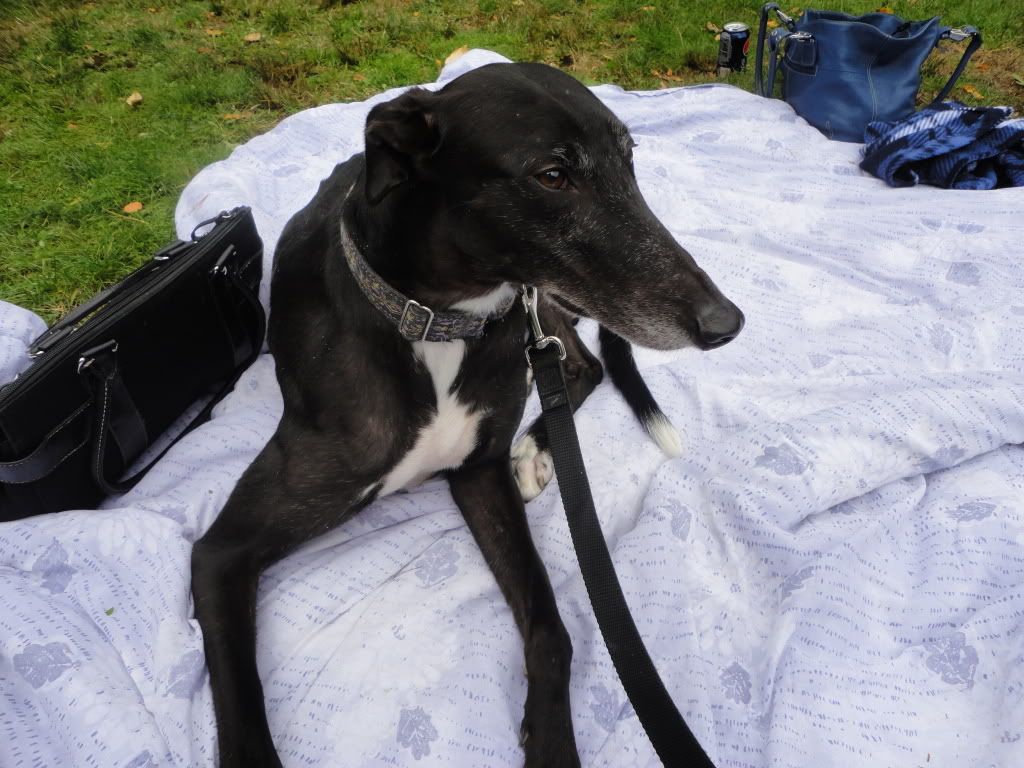
Her name is Taffy: racing name "Tailwaggin' Taffy", daughter of champion racer and stud "Trent Lee" and retired racer "Tailwaggin' Tiff".
While my family has rescued greyhounds for over a decade now, she is the first greyhound we have adopted that has little to no track history. She may have never raced, as she was taken off of the track at age two. She has no scars, no peculiar fears; my family's first greyhound, Gracie, did not like having her ears touched. We were told that sometimes the trainers will grab the dogs by the ears.
She sits. Although greyhounds can be taught how to sit (it will look like an awkward crouch), it is not encouraged in their training- nor is barking. I suppose when you have several dozen dogs kept in one room at the track, you don't want them all barking your ears off.
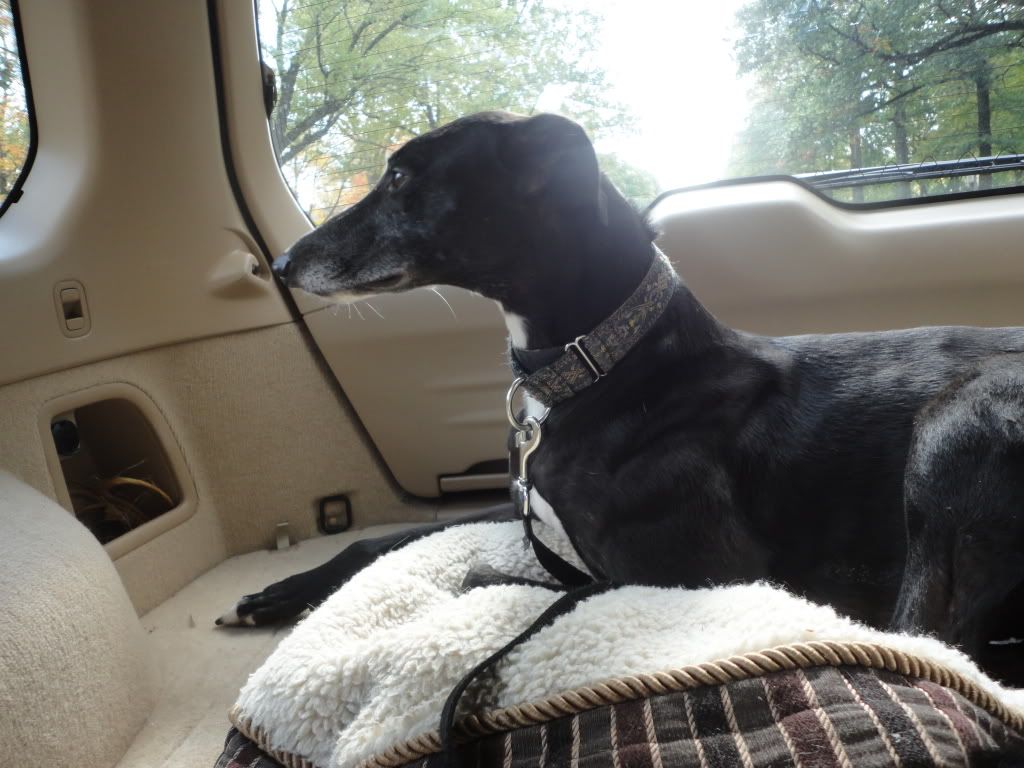
My dog is a happy-go-lucky dog. She likes to go for walks, and loves meeting new people and dogs. She is curious and very loyal, not leaving my side even when I'm just doing yard work. Although she loves to run, she enjoys napping on the couch more- they are not endurance dogs, they sprint around the yard once or twice and are done for the day.
Greyhounds make fantastic pets. They are quiet, good apartment dogs and they are low energy. As long as there is greyhound racing, there is a need for foster parents (who show these dogs what "stairs" are and what "glass" means), and for education on the true, gentle nature of the dogs.
For more information on track life and rescue, contact your local greyhound rescue group.
Subscribe to:
Posts (Atom)